최근 국내 증시가 롤러코스터를 타듯 요동치면서 투자자들의 마음도 함께 출렁이고 있습니다. 이처럼 불안정한 시장 환경에서 자산가들은 어떤 투자 전략을 선택하고 있을까요? 30억 이상 자산을 운용하는 '큰손'들의 최근 행보를 통해 불확실성 시대의 현명한 자산 관리 방법을 알아보겠습니다.
4년 만에 최고 수준으로 치솟은 증시 변동성
이달 국내 증시 변동성이 4년 만에 최고 수준으로 치솟았습니다. 미국 정부의 관세 정책이 종잡을 수 없이 변화하며 시장 불확실성을 키우고 있기 때문입니다^1. 한국거래소에 따르면 이달 들어 지난 11일까지 코스피지수의 일중 변동률은 1.97%로, 2021년 2월(2.03%) 후 4년 2개월 만에 가장 높은 수치를 기록했습니다^1.
일중 변동률이란 당일 지수의 평균값 대비 고가와 저가의 변동폭이 얼마나 컸는지를 나타냅니다. 변동률이 클수록 시장이 크게 요동쳤다는 의미입니다^1. 일별로 살펴보면, 트럼프 행정부가 상호관세를 발표한 지난 3일 일중 변동률은 2.09%를, 4일에는 2.78%까지 치솟았습니다^7.
한국형 공포지수로 불리는 '코스피200 변동성지수(VKOSPI)'도 급등락을 반복했습니다. 코스피가 5% 넘게 급락한 지난 7일 VKOSPI는 전날 대비 65% 급등해 작년 8월 '블랙먼데이' 이후 최고치인 44.23을 기록했다가, 이튿날은 14% 급락해 37.83으로 떨어졌습니다^7. 이러한 변동성은 투자자들에게 큰 불안감을 주고 있습니다.
관세 정책의 오락가락, 증시 롤러코스터의 원인
이처럼 증시가 롤러코스터를 타는 주된 이유는 미국과 중국 간 '관세 난타전'이 이어지고 있기 때문입니다. 중국 국무원은 11일 미국산 수입품 관세율을 기존 84%에서 125%로 인상했습니다. 이는 미국이 중국에 대한 누적 관세율을 145%로 높인 데 따른 보복성 조치였습니다^1.
트럼프 정부의 관세 발표 이후 7일 코스피는 5.57% 급락했고, 상호관세 발효일인 9일에는 1년 5개월여 만에 2,300선 아래로 주저앉았습니다. 그러나 트럼프 대통령의 관세 부과 유예 소식에 다음날은 6.6% 급등하는 등 증시가 하루 만에 천당과 지옥을 오가고 있습니다^7.
큰손들의 선택: 안전자산으로의 '머니무브'
시장 변동성이 커지면서 안전자산 선호 심리도 강해지고 있습니다. 한국경제신문이 NH투자증권에 의뢰해 이 증권사 계좌에서 30억원 이상을 굴리는 고액 자산가의 포트폴리오를 분석한 결과, 흥미로운 투자 패턴이 드러났습니다^1.
금과 RP 중심의 안전자산 비중 확대
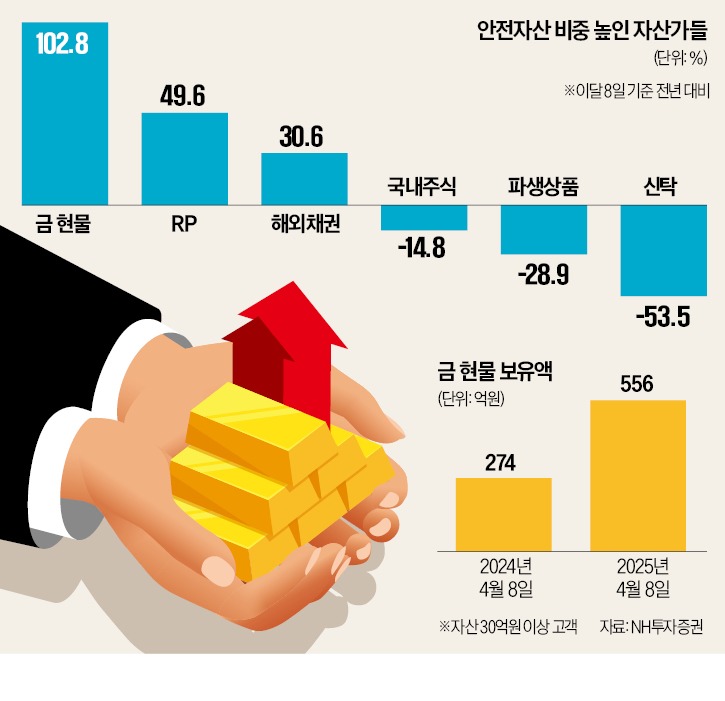
지난 8일 기준 고액 자산가들의 금 현물 보유액은 556억원으로 1년 전(274억원) 대비 두 배 이상으로 늘었습니다. 전체 투자 자산 가운데 증가폭이 가장 컸습니다^1. 도널드 트럼프 미국 행정부 출범 이후 불확실성이 커지면서 금 투자 수요가 증가한 데다 금 현물 가격(KRX 금시장 기준)이 이 기간 39.14% 올라 평가 가치가 상승했기 때문입니다^1.
현금성 자산인 환매조건부채권(RP) 보유금액은 2327억원에서 3481억원으로 늘어 2위(49.6%)를 차지했습니다. 주식시장이 요동치자 안정적으로 자금을 굴릴 수 있는 RP 비중을 늘린 영향입니다^1.
위험자산은 과감히 정리
반면, 큰손들은 위험자산 비중은 과감히 줄여나갔습니다. NH투자증권 고액 자산가들의 국내 주식 보유금액은 3조9490억원으로 한 해 전(4조6332억원)보다 14.8% 줄었습니다^1. 신탁 자산은 1조795억원에서 5015억원으로 53.5% 급감했고, 파생상품 투자는 2670억원에서 1899억원으로 28.9% 줄었습니다^1.
시장 변동성이 커진 이달(4월 1~8일)로 기간을 좁혀보면 안전자산 선호 심리가 더욱 두드러졌습니다. 전체 자산군 가운데 RP, 국내 채권, 발행어음, 현금 등만 보유비중이 늘었습니다^1. 나스닥종합지수가 이틀(4월 3-4일) 사이 11.79% 폭락한 데 이어 7일 코스피지수까지 2300선으로 주저앉자 대표적인 안전자산으로 '머니무브'가 이뤄졌다고 시장 전문가들은 분석하고 있습니다^1.
RP(환매조건부채권)란 무엇인가? 불안정한 시장에서 주목받는 이유
RP(환매조건부채권)는 증시 변동성이 커질 때 큰손들이 특히 선호하는 안전자산입니다. 하지만 일반 투자자들에게는 다소 생소한 금융상품일 수 있습니다. RP가 정확히 무엇이고, 왜 불안정한 시장에서 주목받는지 알아봅시다.
RP의 개념과 구조
RP는 증권사가 고객에게 채권을 판매하고 일정 기간 다시 매수하는 조건으로 거래하는 금융 상품입니다^1. 구조를 이해하자면, 소비자가 증권사에 돈을 맡기고 증권사는 그 돈만큼의 국채를 담보로 소비자에게 맡깁니다^4. 이후 약속된 기간이 지나면 증권사는 원금과 이자를 지급하는 방식입니다.
이 과정에서 담보로 제공되는 것은 주로 국공채나 특수채 등 우량 채권입니다. 대한민국이 망하지 않는 이상 절대로 망할 일이 없는 국채가 담보이기 때문에 엄청나게 안정적인 자산으로 평가받습니다^4. 혹시라도 증권사에 문제가 생겨도 투자자는 담보를 확보할 수 있어 이중으로 안전장치가 마련되어 있습니다.
RP의 투자 장점
RP의 장점은 크게 두 가지로 요약됩니다. 첫째, 은행 예적금보다 높은 수익률을 제공합니다. 증권사는 고객 유치를 위해 은행보다 약간 더 높은 이자율을 제공하기 때문입니다^4.
둘째, 안정성이 매우 높습니다. 우량 채권에 투자하기 때문에 원금 손실 위험이 매우 낮고, 담보가 있어 이중 안전장치가 마련되어 있습니다^4. 시장이 불안정할 때 더욱 주목받는 이유입니다.
RP는 수시형과 약정형으로 나뉘는데, 수시형은 언제든지 돈을 넣고 뺄 수 있고 약정형은 정해진 기간 동안 돈이 묶이지만 그만큼 수익률이 더 높습니다^4. 은행의 수시출금 통장과 예적금 개념과 유사하다고 볼 수 있습니다.
과거와 현재, 큰손들의 투자 패턴 비교
현재 자산가들의 투자 패턴은 과거와 어떻게 다를까요? 흥미롭게도 2010년에는 정반대 현상이 관찰되었습니다.
2010년 vs 2025년: 정반대 투자 행보
2010년 삼성증권이 1억 원 이상 예탁한 거액자산가 7만1162명의 자산을 분석한 결과, 당시 거액자산가들은 지난 1년간 현금성 자산(MMF, RP 등)을 각각 26.1%, 15.9% 감소한 반면 주식직접투자 자산은 37.4%가 늘어났습니다^2. 이는 2025년 현재 큰손들이 안전자산 비중을 높이고 주식을 줄이는 것과는 정반대의 움직임입니다.
워런 버핏의 전략: 현금의 중요성
글로벌 최고의 투자자 워런 버핏은 팬데믹 이후에도 현금성 자산을 꾸준히 늘려왔습니다. 2023년 1분기 기준 버크셔 해서웨이의 현금성 자산은 1306억달러(약 168조2128억원)로, 팬데믹 직전인 2019년 12월(1279억달러·약 164조7352억원) 대비 2.1% 늘었습니다^6.
버핏은 "현금은 쓰레기가 아니다. 나를 믿어라"라고 말하며 현금의 중요성을 강조했습니다^6. 그는 2022년 금리 인상이 시작될 때까지 현금을 보유하다가 시장 불안으로 주가가 떨어졌을 때 애플과 옥시덴털 페트롤리엄, TSMC 등의 주식을 대거 사들이는 '저점 매수' 전략을 구사했습니다^6.
전문가들의 조언: 당분간 위험자산 회피 전략 유지
자산가들의 위험자산 회피 심리는 당분간 지속될 것이라는 게 시장 전문가들의 전망입니다. 미·중 양국 간 '관세 난타전'이 이어지고 있기 때문입니다^1.
성현희 NH투자증권 프리미어블루 강남센터장은 "관세 충격 당시 언제쯤 시장이 안정세를 보일 것인지에 대한 문의가 가장 많았다"며 "그동안 해외 주식에서 얻은 수익을 RP와 발행어음 등 현금성 자산으로 옮기는 분위기"라고 말했습니다^1.
또한 "불안감이 큰 상황에서 기준금리 인하를 기대하고 국채를 추가 매입하려는 움직임도 있다"며 "절세 효과를 누릴 수 있는 저쿠폰(낮은 액면금리) 장기채 등이 주요 고려 대상"이라고 덧붙였습니다^1.
하지만 모든 전문가가 같은 의견은 아닙니다. 박승영 한화투자증권 연구원은 "코스피는 여전히 매도보다 매수가 유리한 구간으로 판단한다"며 "코스피 현재 주가순자산비율(PBR) 0.8배는 2001년 이후 6000여 거래일 중 단 2.2%만 하회했던 드문 수준"이라고 설명했습니다^8. 그는 국내 주식의 비중 확대를 권한다고 조언했습니다.
일반 투자자를 위한 RP 활용 전략
큰손들처럼 RP를 활용한 안전자산 투자는 일반 투자자들에게도 유용한 전략이 될 수 있습니다. RP를 효과적으로 활용하는 두 가지 방법을 소개합니다.
1. 주식 매매 후 남은 자금의 효율적 운용
주식을 사고 남은 돈, 혹은 더 좋은 매수 기회를 기다리며 보유 중인 현금은 투자자 예탁금 계좌에 그냥 두기보다 RP로 운용하는 것이 유리합니다^4. 투자자 예탁금으로 쌓인 자금은 우리나라에만 60-70조에 이르는데, 이 자금을 그냥 두면 증권사만 이득을 보게 됩니다^4. 주식 매매를 위한 자금이라도 단기간 RP에 넣어두면 이자 수익을 얻을 수 있습니다.
2. 목돈 파킹용으로 활용
목돈이 생겼는데 당장 투자하기는 애매하고, 인플레이션 때문에 가만히 두기도 아깝다면 RP가 좋은 대안이 될 수 있습니다^4. 은행 예적금보다 절차가 간단하고(버튼 몇 번만 클릭하면 됨), 수익률은 더 높아 목돈 파킹용으로 효율적입니다.
결론: 불확실성 시대, 현명한 자산 관리의 키워드는 '안전'
미·중 간 관세 전쟁, 트럼프 행정부의 예측 불가능한 정책 등으로 증시 변동성이 커진 상황에서 자산가들은 안전자산으로 자금을 이동하는 '머니무브'를 하고 있습니다. 특히 금, RP, 국내 채권 등 안전자산 비중을 늘리고, 주식과 파생상품 등 위험자산 비중은 줄이는 보수적인 전략이 두드러집니다.
워런 버핏이 보여준 것처럼, 변동성이 큰 시기에는 현금과 같은 안전자산을 보유함으로써 시장이 안정되거나 저점에 도달했을 때 좋은 기회를 잡을 수 있습니다. 일반 투자자들도 이러한 큰손들의 전략을 참고하여, 현재 시장 상황에서는 안전자산 비중을 적절히 높이는 것을 고려해볼 만합니다.
하지만 모든 투자는 개인의 투자 성향과 목표에 맞게 이루어져야 합니다. 시장의 과도한 공포에 휩쓸리기보다는 장기적인 관점에서 균형 잡힌 포트폴리오를 구성하는 것이 중요합니다. 지금처럼 변동성이 큰 시기야말로 자신의 투자 원칙을 점검하고 재정비할 좋은 기회가 될 수 있습니다.
여러분은 최근 증시 변동성에 어떻게 대응하고 계신가요? 포트폴리오에 RP와 같은 안전자산의 비중을 조정해 보셨나요? 불확실성의 시대, 현명한 투자로 자산을 지키고 늘려나가시길 바랍니다.
#증시변동성 #RP투자 #환매조건부채권 #안전자산 #현금관리 #자산배분 #포트폴리오관리 #큰손투자전략 #머니무브 #관세정책 #미중무역갈등 #워런버핏 #VKOSPI #투자심리 #시장불확실성 #목돈굴리기 #자산관리팁
Stock Market Volatility at 4-Year High: Big Investors Shifting to RP and Cash
As the Korean stock market has been experiencing roller-coaster-like fluctuations recently, investors' sentiments have been equally turbulent. In such an unstable market environment, what investment strategies are wealthy individuals choosing? Let's explore how the recent movements of "big hands" (major investors with assets over 3 billion won) can teach us about wise asset management in these uncertain times.
Stock Market Volatility Soars to Highest Level in 4 Years
This month, domestic stock market volatility has soared to its highest level in four years. This is primarily due to the unpredictable shifts in the U.S. government's tariff policies, which are increasing market uncertainty^1. According to the Korea Exchange, the daily volatility of the KOSPI index up to the 11th of this month was 1.97%, the highest figure in 4 years and 2 months since February 2021 (2.03%)^1.
Daily volatility rate measures how much the high and low of the day's index differed from the average value. The higher the volatility, the more significantly the market fluctuated that day^1. Looking at individual days, when the Trump administration announced reciprocal tariffs on the 3rd, daily volatility reached 2.09%, and on the 4th, it soared to 2.78%^7.
The 'KOSPI200 Volatility Index (VKOSPI)', also known as the Korean fear index, has also been showing rapid fluctuations. On the 7th, when the KOSPI plunged more than 5%, the VKOSPI surged 65% from the previous day to 44.23, the highest since last August's 'Black Monday', before falling 14% the next day to 37.83^7. This volatility is causing significant anxiety among investors.
Flip-flopping Tariff Policies: The Cause of the Stock Market Roller Coaster
The main reason the stock market is riding a roller coaster is the ongoing "tariff war" between the United States and China. On the 11th, the Chinese State Council raised tariff rates on U.S. imports from 84% to 125%. This was a retaliatory measure after the United States raised its cumulative tariff rate on China to 145%^1.
After the Trump administration's tariff announcement, the KOSPI plunged 5.57% on the 7th, and on the 9th, the day the reciprocal tariffs took effect, it fell below 2,300 for the first time in a year and five months. However, following news of President Trump's postponement of tariff implementation, it surged 6.6% the next day, showing how quickly the market can swing between extremes^7.
The Choice of Big Investors: 'Money Move' to Safe Assets
As market volatility increases, the preference for safe assets is also strengthening. When the Korea Economic Daily commissioned NH Investment & Securities to analyze the portfolios of high-asset clients (those with accounts exceeding 3 billion won), interesting investment patterns emerged^1.
Expanding the Proportion of Safe Assets Centered on Gold and RP
As of the 8th, high-asset clients' gold holdings amounted to 55.6 billion won, more than double the amount from a year ago (27.4 billion won). This showed the largest increase among all investment assets^1. This is because demand for gold investment has increased due to growing uncertainty after the inauguration of the Donald Trump U.S. administration, and the price of gold bullion (based on the KRX gold market) has risen by 39.14% during this period, increasing its valuation^1.
Repurchase agreement (RP) holdings, a cash-like asset, increased from 232.7 billion won to 348.1 billion won, ranking second with a 49.6% increase. This reflects a growing preference for RPs as a way to manage funds safely while the stock market fluctuates^1.
Boldly Reducing Risky Assets
Meanwhile, major investors have been boldly reducing their holdings of risky assets. Domestic stock holdings of NH Investment & Securities' high-asset clients amounted to 3.949 trillion won, down 14.8% from a year earlier (4.6332 trillion won)^1. Trust assets plummeted by 53.5% from 1.0795 trillion won to 501.5 billion won, and derivative investments decreased by 28.9% from 267 billion won to 189.9 billion won^1.
Looking specifically at this month (April 1-8), the preference for safe assets became even more pronounced. Among all asset classes, only the proportion of RPs, domestic bonds, bills, and cash increased^1. Market experts analyze that after the Nasdaq Composite Index plunged 11.79% in two days (April 3-4) and the KOSPI index fell to the 2300 level on the 7th, a "money move" to representative safe assets occurred^1.
What is RP (Repurchase Agreement)? Why It's Gaining Attention in Unstable Markets
RP (Repurchase Agreement) is a safe asset particularly preferred by major investors when stock market volatility increases. However, it may be somewhat unfamiliar to general investors. Let's understand what exactly RP is and why it's gaining attention in unstable markets.
Concept and Structure of RP
RP is a financial product where a securities company sells bonds to a customer and then trades with the condition of repurchasing them after a certain period^1. To understand the structure, consumers deposit money with a securities company, and the securities company deposits government bonds as collateral to the consumer for that amount^4. After the agreed period, the securities company pays the principal and interest.
In this process, the collateral provided is mainly high-quality bonds such as government bonds or special bonds. Since government bonds, which would only fail if the Republic of Korea were to collapse, serve as collateral, this is evaluated as an extremely stable asset^4. Even if there were issues with the securities company, investors could secure the collateral, providing a double safety mechanism.
Investment Advantages of RP
The advantages of RP can be summarized in two main points. First, it offers higher returns than bank deposits. This is because securities companies provide slightly higher interest rates than banks to attract customers^4.
Second, it has very high stability. Since it invests in high-quality bonds, the risk of principal loss is very low, and the presence of collateral provides a double safety mechanism^4. This is why it receives more attention when the market is unstable.
RP is divided into on-demand and term types. The on-demand type allows you to deposit and withdraw money at any time, while the term type locks your money for a set period but offers higher returns in exchange^4. This can be seen as similar to the concepts of bank current accounts and fixed deposits.
Comparing Past and Present: Investment Patterns of Big Investors
How do wealthy individuals' current investment patterns differ from the past? Interestingly, the opposite phenomenon was observed in 2010.
2010 vs 2025: Opposite Investment Moves
In 2010, when Samsung Securities analyzed the assets of 71,162 high-value clients who had deposited more than 100 million won, these wealthy clients had reduced their cash-like assets (MMF, RP, etc.) by 26.1% and 15.9% respectively over the previous year, while their direct stock investment assets increased by 37.4%^2. This is exactly the opposite of the current movement in 2025, where big investors are increasing their proportion of safe assets and reducing stocks.
Warren Buffett's Strategy: The Importance of Cash
Global top investor Warren Buffett has consistently increased his cash-like assets even after the pandemic. As of the first quarter of 2023, Berkshire Hathaway's cash-like assets amounted to 130.6 billion dollars (approximately 168.2128 trillion won), up 2.1% from December 2019 (127.9 billion dollars, approximately 164.7352 trillion won) just before the pandemic^6.
Buffett emphasized the importance of cash, saying, "Cash is not trash. Trust me."^6 He maintained cash until interest rates began to rise in 2022, and then employed a "bottom-buying" strategy, purchasing large amounts of shares in companies like Apple, Occidental Petroleum, and TSMC when market anxiety caused stock prices to fall^6.
Expert Advice: Maintain Risk Asset Avoidance Strategy for Now
Market experts predict that investors' risk asset avoidance psychology will continue for the time being. This is because the "tariff battle" between the United States and China continues^1.
Sung Hyun-hee, head of NH Investment & Securities' Premier Blue Gangnam Center, said, "The most frequent inquiry was about when the market would stabilize after the tariff shock," and noted, "There's a trend of moving profits from overseas stocks to cash-like assets such as RP and bills."^1
She also added, "In a situation of high anxiety, there is also a movement to expect interest rate cuts and purchase additional government bonds," and noted that "low coupon (low face value interest rate) long-term bonds that can enjoy tax savings effects are major considerations."^1
However, not all experts share the same opinion. Park Seung-young, a researcher at Hanwha Investment & Securities, said, "I believe KOSPI is still in a range where buying is more advantageous than selling," explaining that "the current KOSPI price-to-book ratio (PBR) of 0.8 times is a rare level that only 2.2% of the more than 6,000 trading days since 2001 have fallen below."^8 He advised increasing the proportion of domestic stocks.
RP Utilization Strategies for General Investors
Safe asset investment using RP, like big investors, can also be a useful strategy for general investors. Here are two ways to effectively utilize RP.
1. Efficient Operation of Funds Remaining After Stock Trading
It is more advantageous to operate money left over after buying stocks, or cash held while waiting for better buying opportunities, in RP rather than just leaving it in the investor deposit account^4. Funds accumulated as investor deposits amount to 60-70 trillion won in Korea alone, and if this money is left idle, only the securities company benefits^4. Even if the funds are for stock trading, placing them in short-term RP can earn interest income.
2. Using as a Parking Spot for Lump Sum Money
If you have a lump sum of money but are unsure about investing it immediately, and it's wasteful to leave it idle due to inflation, RP can be a good alternative^4. It's simpler than bank deposits (just a few button clicks) and offers higher returns, making it efficient for parking lump sums.
Conclusion: In an Age of Uncertainty, the Keyword for Wise Asset Management is 'Safety'
In a situation where stock market volatility has increased due to the tariff war between the U.S. and China and the unpredictable policies of the Trump administration, wealthy individuals are making a "money move" to safe assets. A conservative strategy of increasing the proportion of safe assets like gold, RP, and domestic bonds, while reducing the proportion of risky assets like stocks and derivatives, is particularly noticeable.
As Warren Buffett has shown, during periods of high volatility, holding safe assets like cash can provide good opportunities when the market stabilizes or reaches its bottom. General investors can also consider appropriately increasing the proportion of safe assets in the current market situation, referencing these strategies of big investors.
However, all investments should be made according to individual investment tendencies and goals. Rather than being swept away by excessive market fear, it's important to maintain a balanced portfolio from a long-term perspective. Times of high volatility like now can be a good opportunity to check and reorganize your investment principles.
How are you responding to recent stock market volatility? Have you adjusted the proportion of safe assets like RP in your portfolio? In these uncertain times, I hope you protect and grow your assets through wise investments.
#StockMarketVolatility #RPInvestment #RepurchaseAgreement #SafeAssets #CashManagement #AssetAllocation #PortfolioManagement #BigInvestorStrategy #MoneyMove #TariffPolicy #USTradeTension #WarrenBuffett #VKOSPI #InvestorSentiment #MarketUncertainty #LumpSumManagement #AssetManagementTips
#증시변동성 #RP투자 #환매조건부채권 #안전자산 #현금관리 #자산배분 #포트폴리오관리 #큰손투자전략 #머니무브 #관세정책 #미중무역갈등 #워런버핏 #VKOSPI #투자심리 #시장불확실성 #목돈굴리기 #자산관리팁
⁂
'이슈' 카테고리의 다른 글
| 만트라의 두 얼굴: 8조원이 증발한 암호화폐와 마음을 다스리는 명상 도구 (8) | 2025.04.14 |
|---|---|
| 장도연 도둑설의 진실: 박나래 자택 도난 사건과 억울한 누명 속 빛난 18년 우정 (3) | 2025.04.14 |
| 김영철, 10살 연하 미모의 변호사와 설레는 소개팅 현장 공개! 핑크빛 기류 포착되나? (2) | 2025.04.14 |
| 배우 남윤수 SNS 논란: 우연한 실수와 솔직한 사과 (0) | 2025.04.13 |
| 故 김새론 신내림 의혹: 연예계를 뒤흔든 충격적 폭로의 진실과 그 이면 (1) | 2025.04.13 |


